Get the Damn Story
ebook ∣ Homer Bigart and the Great Age of American Newspapers

Sign up to save your library
With an OverDrive account, you can save your favorite libraries for at-a-glance information about availability. Find out more about OverDrive accounts.

Find this title in Libby, the library reading app by OverDrive.



Search for a digital library with this title
Title found at these libraries:
| Library Name | Distance |
|---|---|
| Loading... |
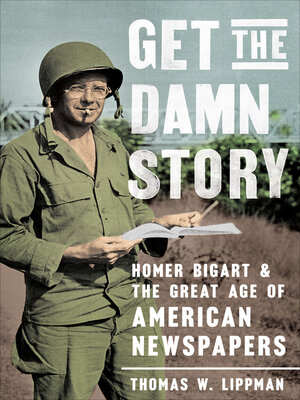
<p><b>The captivating story of an influential journalist demonstrates the value of a free press to democratic society</b></p><p>In the decades between the Great Depression and the advent of cable television, when daily newspapers set the conversational agenda in the United States, the best reporter in the business was a rumpled, hard-drinking figure named Homer Bigart. Despite two Pulitzers and a host of other prizes, he quickly faded from public view after retirement. Few today know the extent to which he was esteemed by his peers.
<I>Get the Damn Story</I> is the first comprehensive biography to encompass all of Bigart's journalism, including both his war reporting and coverage of domestic events. Writing for the <I>New York Herald Tribune </I>and the<I> New York Times</I>, Bigart brought to life many events that defined the era—the wars in Europe, the Pacific, Korea, and Vietnam; the civil rights movement; the creation of Israel; the end of colonialism in Africa; and the Cuban Revolution.
The news media's collective credibility may have diminished in the age of Twitter, but Bigart's career demonstrates the value to a democratic society of a relentless, inquiring mind examining its institutions and the people who run them. The principle remains the same today: the truth matters. Historians and journalists alike will find Bigart's story well worth reading.</p>
<I>Get the Damn Story</I> is the first comprehensive biography to encompass all of Bigart's journalism, including both his war reporting and coverage of domestic events. Writing for the <I>New York Herald Tribune </I>and the<I> New York Times</I>, Bigart brought to life many events that defined the era—the wars in Europe, the Pacific, Korea, and Vietnam; the civil rights movement; the creation of Israel; the end of colonialism in Africa; and the Cuban Revolution.
The news media's collective credibility may have diminished in the age of Twitter, but Bigart's career demonstrates the value to a democratic society of a relentless, inquiring mind examining its institutions and the people who run them. The principle remains the same today: the truth matters. Historians and journalists alike will find Bigart's story well worth reading.</p>