Culture and Language at Crossed Purposes
ebook ∣ The Unsettled Records of American Settlement

Sign up to save your library
With an OverDrive account, you can save your favorite libraries for at-a-glance information about availability. Find out more about OverDrive accounts.

Find this title in Libby, the library reading app by OverDrive.



Search for a digital library with this title
Title found at these libraries:
| Library Name | Distance |
|---|---|
| Loading... |
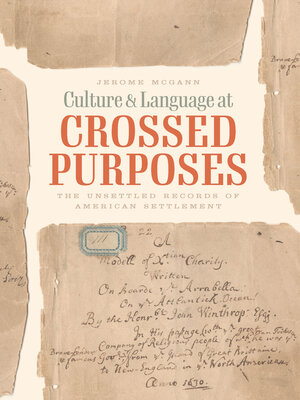
Culture and Language at Crossed Purposes unpacks the interpretive problems of colonial treaty-making and uses them to illuminate canonical works from the period.
Classic American literature, Jerome McGann argues, is haunted by the betrayal of seventeenth- and eighteenth-century Indian treaties—"a stunned memory preserved in the negative spaces of the treaty records." A noted scholar of the "textual conditions" of literature, McGann investigates canonical works from the colonial period, including the Arbella sermon and key writings of William Bradford, John Winthrop, Anne Bradstreet, Cotton Mather's Magnalia, Benjamin Franklin's celebrated treaty folios and Autobiography, and Thomas Jefferson's Notes on the State of Virginia. These are highly practical, purpose-driven works—the record of Enlightenment dreams put to the severe test of dangerous conditions. McGann suggests that the treaty-makers never doubted the unsettled character of what they were prosecuting, and a similar conflicted ethos pervades these works. Like the treaty records, they deliberately test themselves against stringent measures of truth and accomplishment and show a distinctive consciousness of their limits and failures. McGann's book is ultimately a reminder of the public importance of truth and memory—the vocational commitments of humanist scholars and educators.
Classic American literature, Jerome McGann argues, is haunted by the betrayal of seventeenth- and eighteenth-century Indian treaties—"a stunned memory preserved in the negative spaces of the treaty records." A noted scholar of the "textual conditions" of literature, McGann investigates canonical works from the colonial period, including the Arbella sermon and key writings of William Bradford, John Winthrop, Anne Bradstreet, Cotton Mather's Magnalia, Benjamin Franklin's celebrated treaty folios and Autobiography, and Thomas Jefferson's Notes on the State of Virginia. These are highly practical, purpose-driven works—the record of Enlightenment dreams put to the severe test of dangerous conditions. McGann suggests that the treaty-makers never doubted the unsettled character of what they were prosecuting, and a similar conflicted ethos pervades these works. Like the treaty records, they deliberately test themselves against stringent measures of truth and accomplishment and show a distinctive consciousness of their limits and failures. McGann's book is ultimately a reminder of the public importance of truth and memory—the vocational commitments of humanist scholars and educators.