
The Aquacrop Model
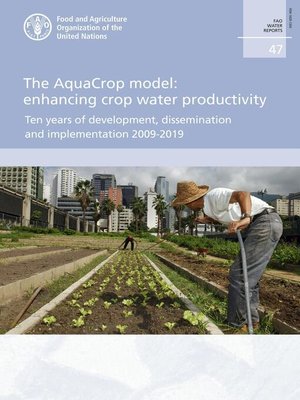
ebook ∣ Enhancing Crop Water Productivity: Ten Years of Development, Dissemination and Implementation 2009–2019
By Food and Agriculture Organization of the United Nations

Sign up to save your library
With an OverDrive account, you can save your favorite libraries for at-a-glance information about availability. Find out more about OverDrive accounts.
Share



Find this title in Libby, the library reading app by OverDrive.



Search for a digital library with this title
Title found at these libraries:
| Library Name | Distance |
|---|---|
| Loading... |
Water resources are linked to the global challenges of food insecurity and poverty, as well as to climate change adaptation and mitigation. In line with the Sustainable Development Goals (SGD), FAO works towards several dimensions of sustainable development, including the promotion of coherent approaches to efficient, productive and sustainable water management, from farm to river basin scales. Accordingly, FAO is enhancing well-informed on-the-ground decision-making processes on water management through projects, knowledge advancement, information-sharing and tools development, such as AquaCrop, the FAO crop-water productivity model. This model assists in assessing the effects of environment (including atmospheric CO2 concentration) and management on crop production through the simulation of yield response to water of herbaceous crops. It is particularly suited to address conditions where water is a key limiting factor in crop production.
In 2009, FAO officially launched AquaCrop, being the result of several years of collaborative work among scientists, water and crop specialists and practitioners worldwide, bringing together previously fragmented information on crop yields in response to water use and water deficit. AquaCrop has evolved over the different versions released since its first launch, but it always balances accuracy, simplicity and robustness. This has enabled it to remain faithful to its goal, i.e., to be a dynamic tool accessible to several types of users, mainly practitioner-type end users, in different disciplines and for a wide range of applications. In addition, AquaCrop may be considered a valuable tool by research scientists for analysis and conceptualization.
Share


