
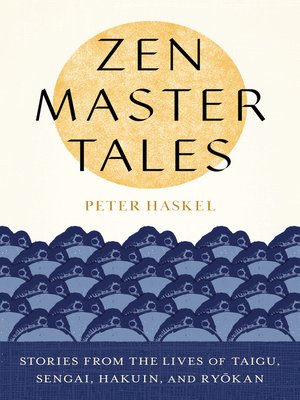
Zen Master Tales
ebook ∣ Stories from the Lives of Taigu, Sengai, Hakuin, and Ryokan
By Peter Haskel

Sign up to save your library
With an OverDrive account, you can save your favorite libraries for at-a-glance information about availability. Find out more about OverDrive accounts.
Share



Find this title in Libby, the library reading app by OverDrive.


Search for a digital library with this title
Title found at these libraries:
| Library Name | Distance |
|---|---|
| Loading... |
A lively collection of folk tales and Buddhist teaching stories from four noted premodern Japanese Zen masters: Taigu Sôchiku (1584–1669), Sengai Gibon (1750-1831), Hakuin Ekaku (1686-1769), and Taigu Ryôkan (1758-1831).
Zen Master Tales collects never before translated stories of four prominent Zen masters from the Edo period of Japanese history (1603-1868). Drawn from an era that saw the “democratization” of Japanese Zen, these stories paint a picture of robust, funny, and poignant engagement between Zen luminaries and the emergent chоnin or “townsperson” culture of early modern Japan. Here we find Zen monks engaging with samurai, merchants, housewives, entertainers, and farmers. These masters affirmed that the essentials of Zen practice—zazen, koan study, even enlightenment—could be conveyed to all members of Japanese society in ordinary speech, including even comic verse and work songs. Against the backdrop of this rich tableau, Zen Master Tales serves not only as a text for Zen students but also as a wide-ranging window onto the fascinating literary, material, and social history of Edo Japan.
In his introduction, translator Peter Haskel explains the history of Zen “stories” from the tradition’s Golden Age in China through the compilation of the classic koan collections and on to the era from which the stories in Zen Master Tales are drawn. What was true of the Chinese tradition, he writes—“its focus on the individual’s ordinary activity as the function, the manifestation of the absolute”—continued in the Japanese context. “Most of these Japanese stories, however unabashedly humorous and at times crude, impart something of the character of the Zen masters involved, whose attainment must be plainly manifest in even the most humble and unlikely of situations.”
Zen Master Tales collects never before translated stories of four prominent Zen masters from the Edo period of Japanese history (1603-1868). Drawn from an era that saw the “democratization” of Japanese Zen, these stories paint a picture of robust, funny, and poignant engagement between Zen luminaries and the emergent chоnin or “townsperson” culture of early modern Japan. Here we find Zen monks engaging with samurai, merchants, housewives, entertainers, and farmers. These masters affirmed that the essentials of Zen practice—zazen, koan study, even enlightenment—could be conveyed to all members of Japanese society in ordinary speech, including even comic verse and work songs. Against the backdrop of this rich tableau, Zen Master Tales serves not only as a text for Zen students but also as a wide-ranging window onto the fascinating literary, material, and social history of Edo Japan.
In his introduction, translator Peter Haskel explains the history of Zen “stories” from the tradition’s Golden Age in China through the compilation of the classic koan collections and on to the era from which the stories in Zen Master Tales are drawn. What was true of the Chinese tradition, he writes—“its focus on the individual’s ordinary activity as the function, the manifestation of the absolute”—continued in the Japanese context. “Most of these Japanese stories, however unabashedly humorous and at times crude, impart something of the character of the Zen masters involved, whose attainment must be plainly manifest in even the most humble and unlikely of situations.”
Share


