
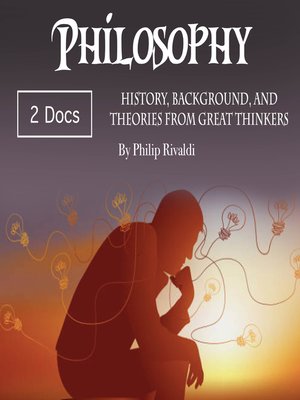
Philosophy
audiobook (Unabridged) ∣ History, Background, and Theories from Great Thinkers
By Philip Rivaldi

Sign up to save your library
With an OverDrive account, you can save your favorite libraries for at-a-glance information about availability. Find out more about OverDrive accounts.
Share



Find this title in Libby, the library reading app by OverDrive.


Search for a digital library with this title
Title found at these libraries:
| Library Name | Distance |
|---|---|
| Loading... |
This book consists of two titles, which are the following:
Book 1: In this convenient guide, several ancient, famous philosophers will be covered, so you may get a better understanding of the ancestors who have shaped our ideas and theories before we were born.
Confucius has definitely left a mark on the world of Eastern philosophy. His ideas were revolutionary and impressive enough for people to follow him, record his works, and start a group of devoted followers. In the first chapter, more light will be shed on this.
The second philosopher mentioned in this guide, is Aristotle, a sharp-minded, focused thinker who received a name with fame. His clinical examinations and his references to Plato and Socrates are known in Greek history.
Third in line is a Chinese thinker named Lao-Tzu, a theorist of the pre-Confucian era who, although he was aware of the power of silence, made sure others knew of his view on life. His influence on Taoism was prevalent.
Book 2: In this book, you will find information about five different philosophers, some of them well-known, others less. But all of them had a significant impact on the ancient world and how people thought, as well as some of our modern-day ideas.
The first in line is Marcus Aurelius, a stoic emperor who reigned with righteousness and justice, according to historical records.
The second is Hipparchia, a cynic who broke through traditions and took a second look at society and its principles.
Third is a somewhat better-known historical figure called Heraclitus of Ephesus. This Greek thinker who noted that "life is flux", meaning that all things change constantly.
Share


