The Idea of Hegel's "Science of Logic"
ebook

Sign up to save your library
With an OverDrive account, you can save your favorite libraries for at-a-glance information about availability. Find out more about OverDrive accounts.

Find this title in Libby, the library reading app by OverDrive.


Search for a digital library with this title
Title found at these libraries:
| Library Name | Distance |
|---|---|
| Loading... |
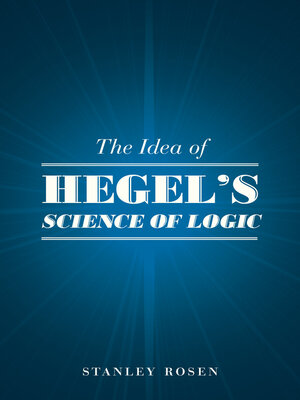
Although Hegel considered Science of Logic essential to his philosophy, it has received scant commentary compared with the other three books he published in his lifetime. Here philosopher Stanley Rosen rescues the Science of Logic from obscurity, arguing that its neglect is responsible for contemporary philosophy's fracture into many different and opposed schools of thought. Through deep and careful analysis, Rosen sheds new light on the precise problems that animate Hegel's overlooked book and their tremendous significance to philosophical conceptions of logic and reason.
Rosen's overarching question is how, if at all, rationalism can overcome the split between monism and dualism. Monism—which claims a singular essence for all things—ultimately leads to nihilism, while dualism, which claims multiple, irreducible essences, leads to what Rosen calls "the endless chatter of the history of philosophy." The Science of Logic, he argues, is the fundamental text to offer a new conception of rationalism that might overcome this philosophical split. Leading readers through Hegel's book from beginning to end, Rosen's argument culminates in a masterful chapter on the Idea in Hegel. By fully appreciating the Science of Logic and situating it properly within Hegel's oeuvre, Rosen in turn provides new tools for wrangling with the conceptual puzzles that have brought so many other philosophers to disaster.
Rosen's overarching question is how, if at all, rationalism can overcome the split between monism and dualism. Monism—which claims a singular essence for all things—ultimately leads to nihilism, while dualism, which claims multiple, irreducible essences, leads to what Rosen calls "the endless chatter of the history of philosophy." The Science of Logic, he argues, is the fundamental text to offer a new conception of rationalism that might overcome this philosophical split. Leading readers through Hegel's book from beginning to end, Rosen's argument culminates in a masterful chapter on the Idea in Hegel. By fully appreciating the Science of Logic and situating it properly within Hegel's oeuvre, Rosen in turn provides new tools for wrangling with the conceptual puzzles that have brought so many other philosophers to disaster.