Non-Sovereign Futures
ebook ∣ French Caribbean Politics in the Wake of Disenchantment

Sign up to save your library
With an OverDrive account, you can save your favorite libraries for at-a-glance information about availability. Find out more about OverDrive accounts.

Find this title in Libby, the library reading app by OverDrive.


Search for a digital library with this title
Title found at these libraries:
| Library Name | Distance |
|---|---|
| Loading... |
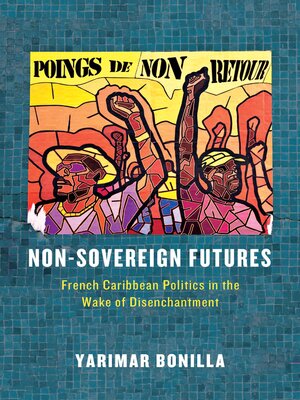
As an overseas department of France, Guadeloupe is one of a handful of non-independent societies in the Caribbean that seem like political exceptions—or even paradoxes—in our current postcolonial era. In Non-Sovereign Futures, Yarimar Bonilla wrestles with the conceptual arsenal of political modernity—challenging contemporary notions of freedom, sovereignty, nationalism, and revolution—in order to recast Guadeloupe not as a problematically non-sovereign site but as a place that can unsettle how we think of sovereignty itself.
Through a deep ethnography of Guadeloupean labor activism, Bonilla examines how Caribbean political actors navigate the conflicting norms and desires produced by the modernist project of postcolonial sovereignty. Exploring the political and historical imaginaries of activist communities, she examines their attempts to forge new visions for the future by reconfiguring narratives of the past, especially the histories of colonialism and slavery. Drawing from nearly a decade of ethnographic research, she shows that political participation—even in failed movements—has social impacts beyond simple material or economic gains. Ultimately, she uses the cases of Guadeloupe and the Caribbean at large to offer a more sophisticated conception of the possibilities of sovereignty in the postcolonial era.
Through a deep ethnography of Guadeloupean labor activism, Bonilla examines how Caribbean political actors navigate the conflicting norms and desires produced by the modernist project of postcolonial sovereignty. Exploring the political and historical imaginaries of activist communities, she examines their attempts to forge new visions for the future by reconfiguring narratives of the past, especially the histories of colonialism and slavery. Drawing from nearly a decade of ethnographic research, she shows that political participation—even in failed movements—has social impacts beyond simple material or economic gains. Ultimately, she uses the cases of Guadeloupe and the Caribbean at large to offer a more sophisticated conception of the possibilities of sovereignty in the postcolonial era.