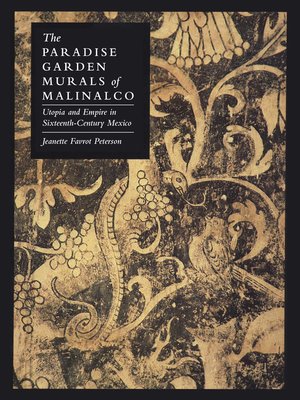
The Paradise Garden Murals of Malinalco
ebook ∣ Utopia and Empire in Sixteenth-Century Mexico

Sign up to save your library
With an OverDrive account, you can save your favorite libraries for at-a-glance information about availability. Find out more about OverDrive accounts.

Find this title in Libby, the library reading app by OverDrive.



Search for a digital library with this title
Title found at these libraries:
| Library Name | Distance |
|---|---|
| Loading... |
Winner, Charles Rufus Morey Award, 1993
The valley of Malinalco, Mexico, long renowned for its monolithic Aztec temples, is a microcosm of the historical changes that occurred in the centuries preceding and following the Spanish conquest in the sixteenth century. In particular, the garden frescoes uncovered in 1974 at the Augustinian monastery of Malinalco document the collision of the European search for Utopia with the reality of colonial life.
In this study, Jeanette F. Peterson examines the murals within the dual heritage of pre-Hispanic and European muralism to reveal how the wall paintings promoted the political and religious agendas of the Spanish conquerors while preserving a record of pre-Columbian rituals and imagery. She finds that the utopian themes portrayed at Malinalco and other Augustinian monasteries were integrated into a religious and political ideology that, in part, camouflaged the harsh realities of colonial policies toward the native population.
That the murals were ultimately whitewashed at the end of the sixteenth century suggests that the "spiritual conquest" failed. Peterson argues that the incorporation of native features ultimately worked to undermine the orthodoxy of the Christian message. She places the murals' imagery within the pre-Columbian tlacuilo (scribe-painter) tradition, traces a "Sahagún connection" between the Malinalco muralists and the native artists working at the Franciscan school of Tlatelolco, and explores mural painting as an artistic response to acculturation.
The book is beautifully illustrated with 137 black-and-white figures, including photographs and line drawings. For everyone interested in the encounter between European and Native American cultures, it will be essential reading.