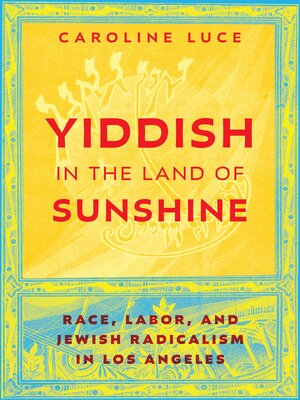
Yiddish in the Land of Sunshine
ebook ∣ Race, Labor, and Jewish Radicalism in Los Angeles · Goldstein-Goren Series in American Jewish Studies ∣ #27 in series

Sign up to save your library
With an OverDrive account, you can save your favorite libraries for at-a-glance information about availability. Find out more about OverDrive accounts.

Find this title in Libby, the library reading app by OverDrive.



Search for a digital library with this title
Title found at these libraries:
| Library Name | Distance |
|---|---|
| Loading... |
How a cohort of young Jewish radicals from the borderlands of Eastern Europe was critical in reshaping multiracial left-wing activism in southern California
Yiddish in the Land of Sunshine offers a novel account of Eastern European Jewish immigration and Yiddish public culture in Southern California. It traces the journeys of a cohort of young Jewish radicals as they moved from the borderlands of the Russian empire to the borderlands of the American southwest, exploring their engagement with well-known labor and left-wing movements in Los Angeles.
Much of the book is focused on Boyle Heights, a residential neighborhood east of the L.A. River once home to the highest concentration of Jews west of Chicago as well as to dozens of other diasporic communities, showing how the neighborhood's particular ethno-racial diversity shaped Yiddish public culture. Rich with new details drawn from previously untranslated Yiddish sources, it examines new relationships and tensions that emerged as the Jewish radicals worked to forge multiracial coalitions in the workplace and the community, including with their Mexican, Asian, and African-American neighbors. It frames the community as a site of convergence, where multiple marginalized populations cultivated their own modes of belonging in overlapping ways, as well as of divergence, where residents' experiences were differentiated by international and domestic political-economic developments.
The book decenters traditional narratives of Jewish immigration and acculturation focused on cities of the northeast, moving Jewish workers in the west from the margins to the center of American Jewish history. It showcases the variety of organizing practices through which Jewish radicals recreated Yiddish public culture in LA, offering a new perspective on the relational dynamics of race and place-making in the American west. Yiddish in the Land of Sunshine recovers the contributions of Eastern European Jewish radicals and trade unionists, demonstrating the ways in which immigrant workers shaped the city of Los Angeles.