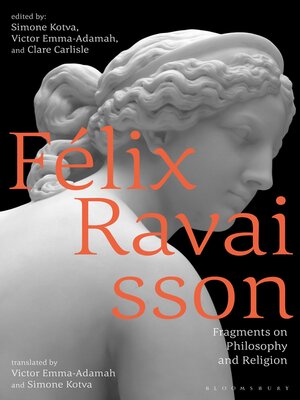
Félix Ravaisson
ebook ∣ Fragments on Philosophy and Religion

Sign up to save your library
With an OverDrive account, you can save your favorite libraries for at-a-glance information about availability. Find out more about OverDrive accounts.

Find this title in Libby, the library reading app by OverDrive.



Search for a digital library with this title
Title found at these libraries:
| Library Name | Distance |
|---|---|
| Loading... |
Félix Ravaisson: Fragments on Philosophy and Religion comprises translations from Ravaisson's notes on the history and philosophy of religion, dating from 1850 to 1900.
Addressing the history of religions, ancient Greek thought, Christian theology, and the philosophy of revelation, these texts are brought to an English audience for the first time here, as the editors place the fragments in the context of Ravaisson's philosophy as a whole.
These unpublished fragments show Ravaisson's lifelong grappling with fundamental questions of theology. They demonstrate that the research into mystery religions, mysticism and the Christian liturgy to which he devoted the end of his long career was not a rupture with the philosophy of his early years. In these texts, Ravaisson elaborated his philosophy of revelation, sacrifice and love, and continued the story he had begun with his study of Aristotle.
Addressing the history of religions, ancient Greek thought, Christian theology, and the philosophy of revelation, these texts are brought to an English audience for the first time here, as the editors place the fragments in the context of Ravaisson's philosophy as a whole.
These unpublished fragments show Ravaisson's lifelong grappling with fundamental questions of theology. They demonstrate that the research into mystery religions, mysticism and the Christian liturgy to which he devoted the end of his long career was not a rupture with the philosophy of his early years. In these texts, Ravaisson elaborated his philosophy of revelation, sacrifice and love, and continued the story he had begun with his study of Aristotle.