
Vali Dakhani and the Early Rekhtah Networks
ebook ∣ Sharing Poetry's Pleasures · Library of Islamic South Asia
By Heidi Pauwels

Sign up to save your library
With an OverDrive account, you can save your favorite libraries for at-a-glance information about availability. Find out more about OverDrive accounts.
Share



Find this title in Libby, the library reading app by OverDrive.


Search for a digital library with this title
Title found at these libraries:
| Library Name | Distance |
|---|---|
| Loading... |
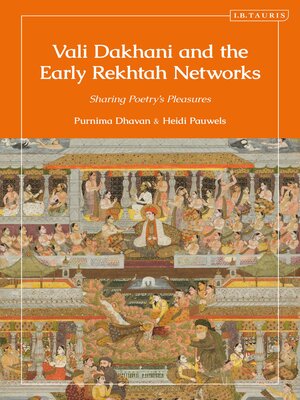
This book reexamines the emergence of Urdu as a literary and poetic language in the 18th century, at the time called Rekhtah, highlighting its engagement with diverse regional cultures and communities in South Asia.
Sharing Poetry's Pleasures reframes the history of Urdu within the diverse contexts from which it emerged. It places the earliest Urdu-Rekhtah poets and their craft in the lively social gatherings, bazaars, shrines, and courts of 18th century South Asia.
Through aesthetic analysis and historical contextualization of poems, using primary sources in manuscripts, the authors reveal why everyday vernaculars, multi-lingual puns, alongside the use of courtly Persian and complex metaphors attracted a wide audience for this new literary language.
Dhavan and Pauwels re-examine the long-dominant mischaracterization of Urdu as an elite language of South Asian Muslims by analysing the poetic biographies of Vali Dakhani and his contemporaries Fa'iz, Abru and Hatim. The authors reveal how selective attention to a handful of poets and rarefied courtly texts obscured the much more diverse roots of an important vernacular tradition, thereby reconstructing a lost literary network of speakers, poets and participants in Urdu's past.
Sharing Poetry's Pleasures reframes the history of Urdu within the diverse contexts from which it emerged. It places the earliest Urdu-Rekhtah poets and their craft in the lively social gatherings, bazaars, shrines, and courts of 18th century South Asia.
Through aesthetic analysis and historical contextualization of poems, using primary sources in manuscripts, the authors reveal why everyday vernaculars, multi-lingual puns, alongside the use of courtly Persian and complex metaphors attracted a wide audience for this new literary language.
Dhavan and Pauwels re-examine the long-dominant mischaracterization of Urdu as an elite language of South Asian Muslims by analysing the poetic biographies of Vali Dakhani and his contemporaries Fa'iz, Abru and Hatim. The authors reveal how selective attention to a handful of poets and rarefied courtly texts obscured the much more diverse roots of an important vernacular tradition, thereby reconstructing a lost literary network of speakers, poets and participants in Urdu's past.
Share


