
Plant-Forward Cuisine
ebook ∣ Basic Concepts and Practical Applications · Routledge Studies in Food, Society and the Environment
By Ole G. Mouritsen

Sign up to save your library
With an OverDrive account, you can save your favorite libraries for at-a-glance information about availability. Find out more about OverDrive accounts.
Share



Find this title in Libby, the library reading app by OverDrive.



Search for a digital library with this title
Title found at these libraries:
| Library Name | Distance |
|---|---|
| Loading... |
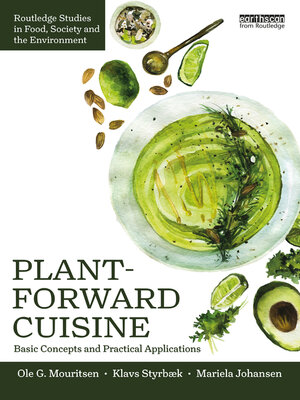
Plant-Forward Cuisine is a beautifully illustrated book that promotes the environmental and health benefits of a plant-forward diet and will inspire readers with a range of exciting recipes.
The book addresses the urgent need to make changes to those culinary cultures where animal-sourced proteins play a central role. To ensure that there is enough food for a growing world population, to lessen the burden on the environment, and to promote healthier, sustainable eating patterns, it is crucial to transition to a diet that focuses primarily on plants as the key ingredients. Yet, many people dislike the taste of plants because of their texture and lack of sweetness and umami. Luckily, the book provides a solution to these challenges. It offers key scientific descriptions of the physical characteristics of plants, mushrooms, algae, and fungi and their nutritional components, along with information about creation of texture and flavour. Armed with this knowledge, the recipes then provide tips and tricks for transforming plants into delicious meals with pleasing textures and flavours. The authors stress that it is not necessary to embrace a fully vegetarian or vegan diet. Rather, they suggest that taking a flexitarian approach, which incorporates small quantities of animal products to elicit umami, may be a more viable and lasting solution for people at large. Throughout the text readers will find interesting narratives about various aspects of green gastronomy around the world. The book concludes with two helpful reference sections: a glossary of main ingredients used in the recipes and a compilation of ingredients that can be used to add taste and aroma.
This book will be of great interest to those concerned with building a sustainable food system, and it will serve as a practical guide for those seeking to transition to plant-rich diets without compromising their taste experience and enjoyment of food.
Share


