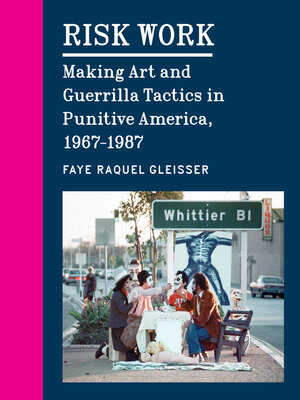
Risk Work
ebook ∣ Making Art and Guerrilla Tactics in Punitive America, 1967–1987

Sign up to save your library
With an OverDrive account, you can save your favorite libraries for at-a-glance information about availability. Find out more about OverDrive accounts.

Find this title in Libby, the library reading app by OverDrive.



Search for a digital library with this title
Title found at these libraries:
| Library Name | Distance |
|---|---|
| Loading... |
How artists in the US starting in the 1960s came to use guerrilla tactics in performance and conceptual art, maneuvering policing, racism, and surveillance.
As US news covered anticolonialist resistance abroad and urban rebellions at home, and as politicians mobilized the perceived threat of "guerrilla warfare" to justify increased police presence nationwide, artists across the country began adopting guerrilla tactics in performance and conceptual art. Risk Work tells the story of how artists' experimentation with physical and psychological interference from the late 1960s through the late 1980s reveals the complex and enduring relationship between contemporary art, state power, and policing.
Focusing on instances of arrest or potential arrest in art by Chris Burden, Adrian Piper, Jean Toche, Tehching Hsieh, Pope.L, the Guerrilla Girls, Asco, and PESTS, Faye Raquel Gleisser analyzes the gendered, sexualized, and racial politics of risk-taking that are overlooked in prevailing, white-centered narratives of American art. Drawing on art history and sociology as well as performance, prison, and Black studies, Gleisser argues that artists' anticipation of state-sanctioned violence invokes the concept of "punitive literacy," a collectively formed understanding of how to protect oneself and others in a carceral society.
As US news covered anticolonialist resistance abroad and urban rebellions at home, and as politicians mobilized the perceived threat of "guerrilla warfare" to justify increased police presence nationwide, artists across the country began adopting guerrilla tactics in performance and conceptual art. Risk Work tells the story of how artists' experimentation with physical and psychological interference from the late 1960s through the late 1980s reveals the complex and enduring relationship between contemporary art, state power, and policing.
Focusing on instances of arrest or potential arrest in art by Chris Burden, Adrian Piper, Jean Toche, Tehching Hsieh, Pope.L, the Guerrilla Girls, Asco, and PESTS, Faye Raquel Gleisser analyzes the gendered, sexualized, and racial politics of risk-taking that are overlooked in prevailing, white-centered narratives of American art. Drawing on art history and sociology as well as performance, prison, and Black studies, Gleisser argues that artists' anticipation of state-sanctioned violence invokes the concept of "punitive literacy," a collectively formed understanding of how to protect oneself and others in a carceral society.